
Knowledge · Substations
Inside a 10(6)/0.4 kV transformer substation
An unremarkable concrete block, a metal cabinet or a transformer on a pole — the last link between the medium-voltage network and the socket. We take a look inside.
Electricity reaches towns, villages and businesses over 10 or 6 kV networks from the supply centres. But households and most businesses need 230/400 V. The step between these levels is provided by a transformer substation (TP). We explain what kinds of substation are found in Ukrainian networks, what they consist of and how they are installed.
The role of a substation in the distribution network
A transformer substation has three main tasks:
- transforming voltage from 10 or 6 kV to 0.4 kV;
- distributing energy between several 0.4 kV lines supplying nearby customers;
- switching and protection — it allows the transformer or individual lines to be disconnected, protects them from short circuits and overloads, and in substations with several line panels also allows the supply to be switched on the MV side.
Substation location is not random. The designer tries to place it as close as possible to the load centre: the shorter the 0.4 kV lines, the lower the voltage drop, and customers at the ends of the lines get better voltage quality. So as development grows it often makes more sense to add a new substation than to extend existing 0.4 kV lines.
Substation types
| Type | Description | Typical use |
|---|---|---|
| ShchTP (pole-mounted) | transformer and equipment on overhead line poles, fed from the overhead line, 0.4 kV switchgear in a cabinet on the pole | rural areas, small loads |
| KTP in a metal enclosure | a factory-built unit with MV, transformer and 0.4 kV compartments; often kiosk-type with external operation | private housing, small businesses, fed from an overhead or cable line |
| BKTP (concrete) | a precast concrete enclosure, often with a cable basement under the floor; may have an internal operating corridor | urban cable networks, residential complexes, solar plants |
| ZTP (indoor) | equipment in a separate building or a built-in room | city centres, large consumers, industrial plants |
Packaged substations dominate new cable networks: they arrive on site as ready, factory-tested modules, which shortens on-site installation and makes quality more consistent. The substation type is chosen according to the supply method (overhead or cable line), capacity, number of 0.4 kV lines, available plot, the DSO's requirements for the scheme and equipment, and access for maintenance and transformer replacement.
Pole-mounted substation
On the pole or group of poles of a pole-mounted substation, the following are installed:
- a disconnector on the tee-off from the overhead line — to provide a visible break during work;
- MV fuses — protect the network from the consequences of a transformer fault;
- surge arresters;
- the power transformer — usually oil-filled;
- a 0.4 kV switchgear cabinet protecting the lines to customers.
The advantages of a pole-mounted substation are low cost and a small footprint; the drawbacks are limited capacity, vulnerability to weather and complete dependence on the overhead line. When 10 kV lines are undergrounded, pole-mounted substations are often replaced with packaged ones.
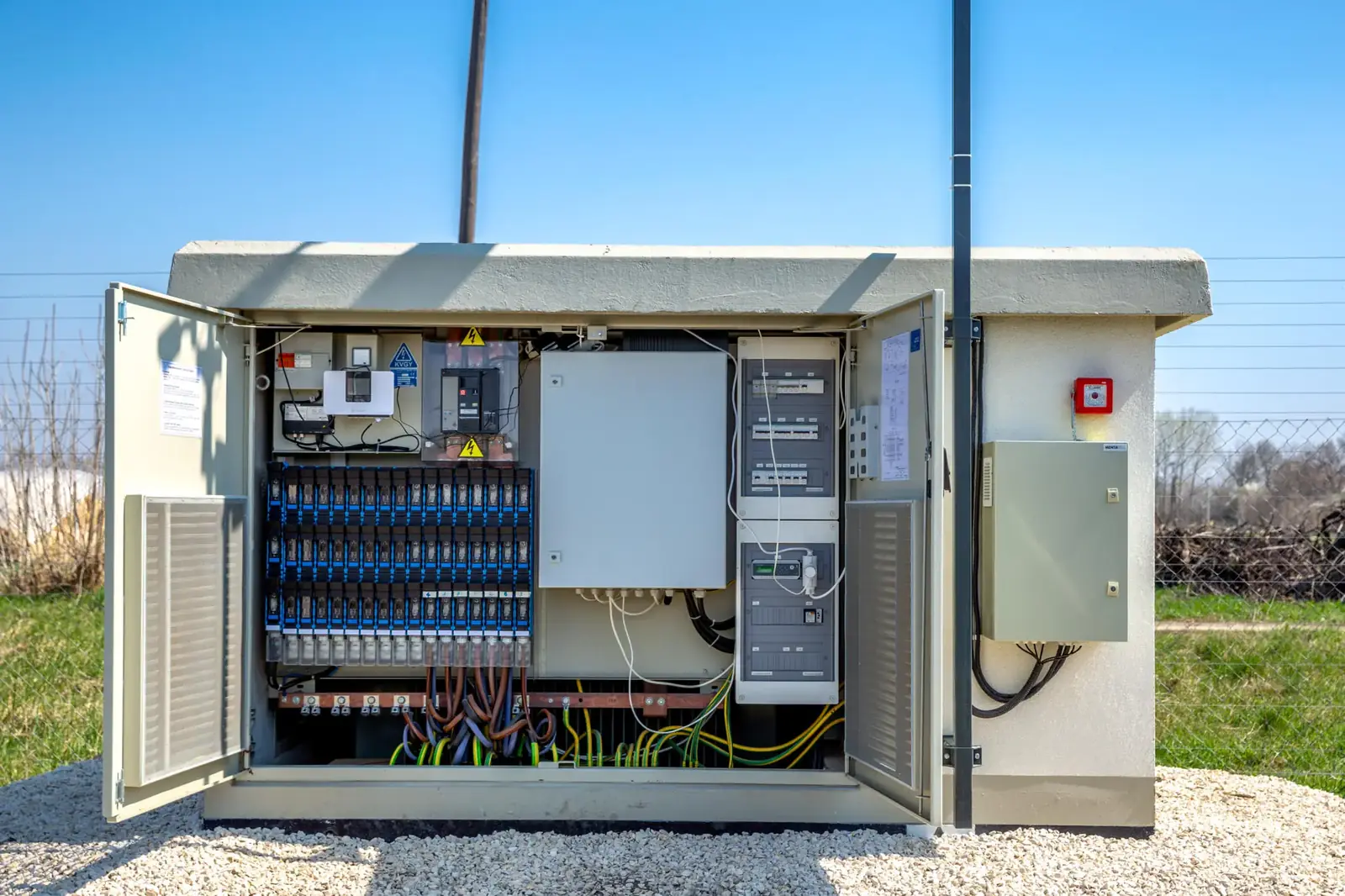
What is inside a packaged substation
- 10(6) kV switchgear compartment — medium-voltage panels to which cables with terminations or T-type connectors are connected.
- Transformer chamber — the power transformer and, for an oil-filled transformer, an oil sump.
- 0.4 kV switchgear compartment — panels with circuit breakers and fuses from which the lines to customers leave.
The enclosure is placed on a prepared base or foundation; cables enter from below through sealed entries. The enclosure provides natural ventilation of the transformer chamber, protection from moisture and unauthorised persons, and carries warning signs.
10(6) kV switchgear — line and transformer panels
- Line panels — MV line cables are connected to them. Two line panels allow the substation to be looped into the line so it can be fed from two directions.
- Transformer panel — feeds the transformer, most often through a load-break switch with fuses or a vacuum circuit breaker with relay protection.
- Metering and other panels — depending on the substation's function, for example for commercial metering at the boundary with the DSO's network.
Older substations have air-insulated cubicles; new ones often use compact SF6-insulated ring main units with built-in earthing switches and interlocks. If the DSO uses network automation, line panels are fitted with motor operators, telemechanics and fault passage indicators.
The power transformer
The key element of a substation is the 10(6)/0.4 kV transformer. Oil-filled transformers prevail in distribution networks, and in new substations they are mostly hermetically sealed, so the oil does not come into contact with air. Inside buildings and where oil is undesirable, dry-type transformers are used.
The transformer rating is matched to the design load and the area's development prospects. The transformer has a tap changer (usually off-circuit, i.e. switched with the transformer de-energised) to match the voltage to conditions at the particular point in the network. The chamber, doors and access are designed so the transformer can later be replaced with a larger one.
0.4 kV switchgear, metering and earthing
The 0.4 kV switchgear distributes energy from the transformer between the outgoing lines, protected by fuses or circuit breakers sized to the line cross-sections and loads. It may also contain technical metering, the substation's auxiliary supply (lighting, heating) and 0.4 kV surge arresters.
In Ukraine, 0.4 kV networks use the TN system — the transformer neutral is solidly earthed. Every substation has an earthing system of vertical and horizontal electrodes around it, to which the transformer neutral, equipment enclosures and cable screens are connected as per the design. The earthing resistance is measured before the substation is put into service; it must comply with the PUE (Ukrainian Electrical Installation Rules) and the design.
How a packaged substation is installed
- Site preparation — survey setting-out, excavation and the base or foundation.
- Earthing — electrodes and conductors are installed before the enclosure is placed; this stage is documented with a certificate of concealed works.
- Placement — the KTP or BKTP units are set in place by crane or by a truck with a loader crane.
- Equipment installation — fitting the transformer if supplied separately, connecting the busbars.
- Cable entry — MV and 0.4 kV cables are brought in through the entries, terminations are fitted and connected to the panels.
- Testing — measuring earthing and insulation resistance, testing equipment and cables, checking operation of devices and interlocks.
- Energisation — after the DSO's technical acceptance, the operator energises the substation and switches customers over.
Logistics matter: concrete units and the transformer are heavy loads, so access, room for a crane and a safe working zone are needed. Before placement the level and bearing capacity of the base are checked, because the correct position of the substation and the tightness of the cable entries depend on them.
We install substations, build their 10 kV supply and 0.4 kV lines, carry out earthing and testing, and can also take on equipment procurement. More on the MV/LV transformer substations page.
See also
Read next
MV/LV substations
Construction of MV/LV transformer substations and cable cabinets, replacement of pole-mounted substations, MV and LV cable connections and acceptance tests.
Learn moreEquipment supply
Procurement for MV and LV networks: АПвЕгП (APvEgP) and АПвП (APvP) cables, joints, cable cabinets, KTP substations and ducts — per design and DSO rules.
Learn moreConnecting a solar farm to the MV grid
How to connect a solar plant to the MV grid in Ukraine: DSO application, connection conditions and agreement, design, construction, acceptance, contracts.
Learn moreNeed a contractor for a 10(6)/0.4 kV substation?
We will install the substation, build the MV supply and 0.4 kV lines, and carry out earthing and testing. Send us the design or a description of the scope.